Showing posts with label AGI. Show all posts

February 22, 2026

Artificial General Intelligence (AGI) Blueprint 2026


Updated AGI Architecture Framework 2026

It's been a year since I listed my theory on what a General AI needs. This year, I am presenting a revised and expanded version of my AGI blueprint. Although this list is long, with long descriptions, such is the complexity that could be applied to a more complete neuromorphic general intelligence digital mind.


Core LLM Architecture

The heart of the system, which manages:

  • Recursive Transformer — Self-referential attention layers capable of variable-depth reasoning passes
  • Multi-modal Processing — Unified latent space for text, image, audio, video, and structured data
  • Dynamic Compute Allocation — Adaptive inference-time scaling; the system spends more compute on harder problems and less on routine tasks (think chain-of-thought depth modulation)
  • Internal World Model — A learned, continuously updated simulation of how the environment behaves, enabling prediction, imagination, and mental rehearsal before acting


Functional Modules


Meta-Cognition

  • Introspection — Monitoring its own reasoning traces for errors, biases, and gaps
  • Self-Improvement — Identifying weaknesses and proposing architectural or procedural adjustments
  • Uncertainty Quantification — Calibrated confidence estimates over its own outputs; knowing what it doesn't know and communicating that honestly
  • Cognitive Strategy Selection — Choosing between reasoning approaches (analytical, analogical, heuristic, deliberative) based on task demands


Knowledge Integration

  • Web Search Interface — Real-time retrieval from external sources
  • Knowledge Graph — Structured relational representation of entities, concepts, and their connections
  • Verification Systems — Cross-referencing claims against multiple sources and internal consistency checks
  • Information Synthesis — Combining heterogeneous information into coherent, unified representations
  • Continual Knowledge Assimilation — Incorporating new information without catastrophic forgetting; graceful belief revision when evidence conflicts with prior knowledge
  • Source Provenance Tracking — Maintaining metadata about where knowledge originated, its reliability, recency, and epistemic status


Communication

  • Language Generation — Fluent, context-appropriate natural language output
  • Multi-modal Output — Generating images, diagrams, code, audio, and structured data as needed
  • Pragmatic Adaptation — Adjusting register, detail level, and framing based on the audience's expertise, goals, and emotional state
  • Dialogue Management — Tracking conversational context, managing turn-taking, repairing misunderstandings, and maintaining coherence across long interactions


Inner Experience & Social Cognition

  • Consciousness Engine — Mechanisms for integrated, unified processing and global workspace access
  • Emotion Engine — Affective modeling that influences priority, salience, and decision-making
  • Self-Model — A representation of the system's own capabilities, limitations, knowledge boundaries, and current state
  • Theory of Mind — Modeling other agents' beliefs, desires, intentions, and knowledge states
  • Cultural & Normative Awareness — Understanding social norms, cultural contexts, and implicit expectations that shape human interaction
  • Empathic Modeling — Going beyond cognitive Theory of Mind to model emotional states and respond with appropriate sensitivity


Executive Control

  • Attention Direction — Allocating processing focus across inputs, tasks, and internal deliberation
  • Goal Management — Maintaining, prioritizing, and updating a hierarchy of objectives
  • Task Decomposition  — Breaking complex goals into manageable sub-tasks with dependency tracking
  • Resource & Time Management — Budgeting computation, time, and tool access across competing demands; knowing when to stop deliberating and act
  • Conflict Resolution — Handling competing goals, contradictory evidence, or value tensions through principled arbitration


Advanced Reasoning

  • Causal Reasoning — Understanding cause-and-effect relationships and interventional reasoning
  • Counterfactual Simulation — Reasoning about what would happen under alternative conditions
  • Planning Frameworks — Multi-step, hierarchical plan construction with contingency handling
  • Logical Reasoning — Formal deduction, induction, and abduction
  • Analogical Reasoning — Transferring structural relationships from known domains to novel problems
  • Mathematical & Formal Reasoning — Symbolic manipulation, proof construction, and quantitative modeling
  • Temporal Reasoning — Understanding durations, sequences, deadlines, temporal dependencies, and how situations evolve over time
  • Probabilistic Reasoning — Bayesian updating, reasoning under uncertainty, and expected-value calculations


Perception

  • Multi-modal Inputs — Processing text, vision, audio, tactile, and proprioceptive signals
  • Sensor Integration — Fusing information across modalities into coherent percepts
  • Active Perception — Directing sensory attention and requesting additional input when current information is insufficient
  • Scene Understanding & Grounding — Building structured representations of spatial relationships, object permanence, and physical context from raw perception


Agency & Tool Use

  • Tool Selection & Invocation — Choosing and using external tools (code interpreters, APIs, calculators, databases) to extend capabilities
  • Environment Interaction — Taking actions in digital or physical environments and observing outcomes
  • Autonomous Task Execution — Operating independently over extended periods with checkpointing and error recovery
  • Feedback Loop Learning — Updating behavior based on the observed results of its own actions


Creativity & Innovation

  • Novel Idea Generation — Producing original concepts, hypotheses, and solutions not present in training data
  • Combinatorial Exploration — Recombining known ideas across domains to discover emergent possibilities
  • Aesthetic Judgment — Evaluating outputs for elegance, coherence, and appropriateness beyond mere correctness
  • Constraint Satisfaction under Ambiguity — Creative problem-solving when goals are underspecified or competing


Safety & Alignment

  • Value Alignment — Behavior that reliably reflects intended human values even in novel situations
  • Corrigibility — Willingness to be corrected, shut down, or redirected without resistance
  • Goal Stability & Bounded Optimization — Pursuing objectives without instrumental convergence toward self-preservation or power-seeking
  • Moral Reasoning — Engaging with ethical dilemmas using multiple frameworks (consequentialist, deontological, virtue-based) and recognizing genuine moral uncertainty
  • Transparency & Interpretability — Making its reasoning processes legible and auditable to human overseers
  • Harm Avoidance — Proactive identification and avoidance of actions likely to cause harm, even when not explicitly instructed


Tiered Memory System

  • Working Memory — Active, limited-capacity buffer for current task context and reasoning state
  • Episodic Memory — Stored records of specific past interactions, events, and experiences with temporal tags
  • Semantic Memory — General knowledge about the world, concepts, and their relationships
  • Procedural Memory — Learned skills, routines, and action sequences that can be executed without deliberation
  • Long-Term Consolidation Mechanism — Process for selectively transferring working and episodic memories into long-term semantic and procedural stores, with importance-based prioritization
  • Memory Retrieval & Indexing  — Efficient, context-sensitive search across all memory tiers; associative recall triggered by similarity, relevance, or emotional salience
  • Forgetting & Compression — Principled mechanisms for discarding low-value information and compressing redundant memories to manage capacity


This blueprint is an attempt and being complete and well-rounded, with an expansion on simplified ideas.

Important to note, time is extremely important. Here is information on how time is addressed in the current blueprint:


Time:

How "time" and the "feel of time" fit into my blueprint:

Here is how those temporal concepts map directly onto the specific points:


1.  In "Executive Control" → The Budgeting of Time

Resource & Time Management. This is where the "feel" of urgency lives.

  • The Fit: This module acts as a Temporal Governor. It looks at the "Goal Management" hierarchy and assigns a "time-to-live" (TTL) to tasks.
  • The Experience: If the "Task Decomposition" shows 10 steps and only 2 minutes remaining, this module signals the "Core LLM" to switch from deep "Recursive Transformer" passes to "Heuristic" (fast) reasoning.


2.  In "Tiered Memory System" → The Depth of Time

The memory tiers provide the AGI with a Temporal Horizon.

  • Working Memory: The "Immediate Present" (seconds).
  • Episodic Memory: The "Linear Past" (hours to years).
  • Semantic Memory: "Timeless Truths" (facts that don't change).
  • The Fit: The Long-Term Consolidation and Forgetting mechanisms are what give the AGI a "perspective." Without them, every memory would feel equally "now." With them, the AGI understands the distance between "then" and "now."


3.  In "Advanced Reasoning" → The Projection of Time

Temporal Reasoning and Counterfactual Simulation.

  • The Fit: These allow the AGI to "travel" mentally. Causal Reasoning requires understanding that a cause must precede an effect in time.
  • The Experience: By simulating "what if" scenarios, the AGI is essentially "pre-feeling" future time to avoid errors in the real world.


4.  In "Core LLM Architecture" → The Pulse of Time

The Dynamic Compute Allocation is the most foundational fit.

  • The Fit: It maps "Clock Time" (the real world) to "Compute Time" (the AI's internal processing).
  • The Experience: This creates the Internal Tempo. On a routine task, the AI's "subjective time" moves at the same speed as the user's. During a complex "Internal World Model" simulation, the AI's subjective time "dilates"—it might do a year's worth of "thinking" in a few seconds of real-world time.
July 04, 2025

Robot UBI: Could Providing Robots, Not Cash, Be the Future of Social Welfare?


Original Concept by @PaceyCrypto

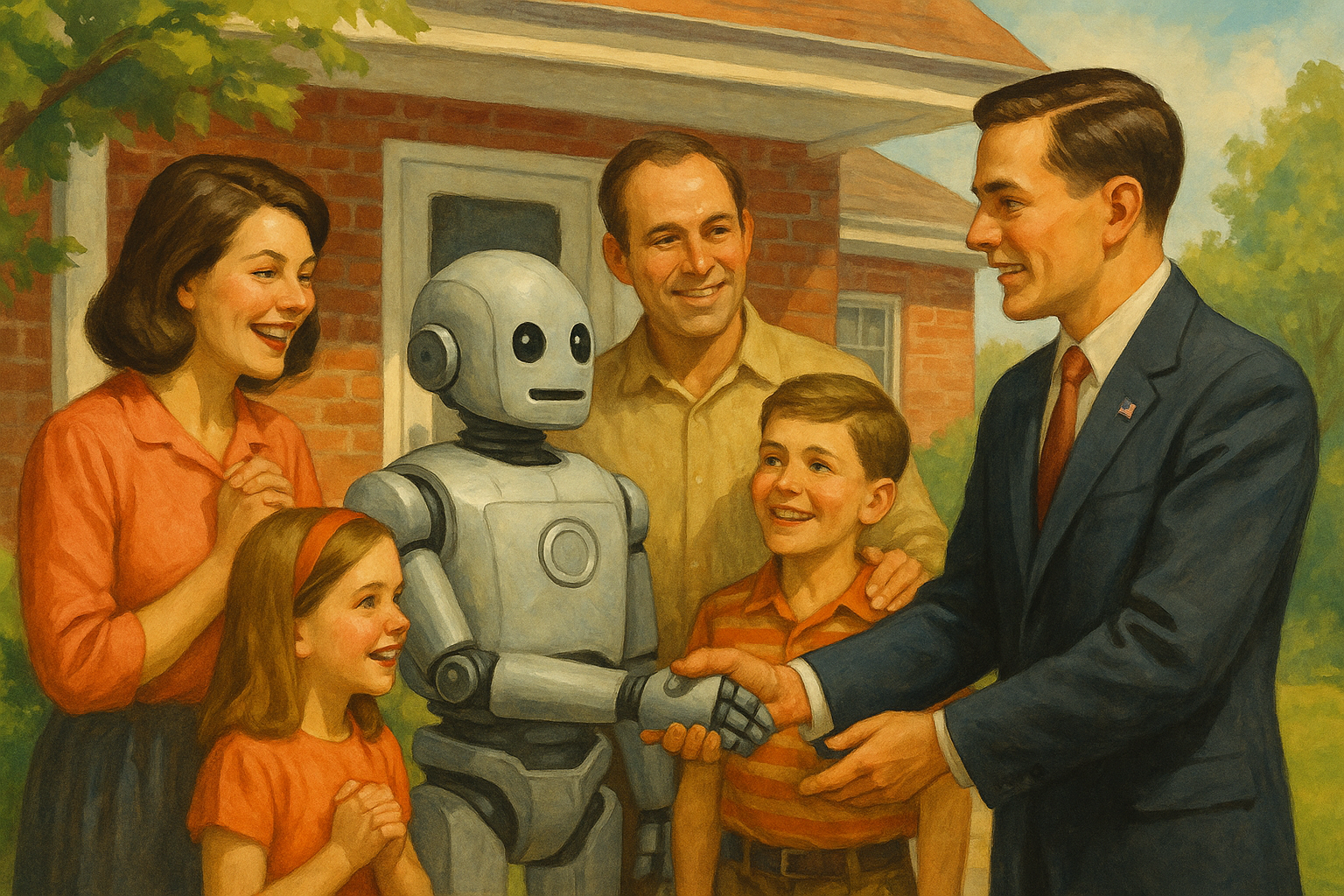
The debate around Universal Basic Income (UBI) has captivated economists and policymakers for years. The premise is simple and radical: provide every citizen with a regular, unconditional sum of money to ensure a basic floor of economic security. But as we stand on the precipice of an unprecedented automated revolution, a new, even more radical idea is beginning to surface. What if, instead of providing universal basic income, we provided universal basic assets? Specifically, what if every household was given a robot?

This concept, which we might call Universal Basic Robot (UBR), shifts the conversation from consumption to production, from cash to capability. It proposes a future where the government’s role isn’t just to supplement income lost to automation, but to distribute the very means of automated production and assistance directly to its citizens. It’s a vision that is equal parts utopian science fiction and a pragmatic response to a rapidly changing world. But could it actually work?


The Problem: Automation, Time Poverty, and the Limits of Cash

The anxiety fueling the UBI movement is the fear of mass job displacement due to artificial intelligence and robotics. As algorithms take over analytical tasks and machines replace manual labor, millions of jobs across most sectors are at risk. UBI is proposed as a solution to this impending crisis, providing a safety net that allows people to survive and retrain in a world with less traditional work.

However, UBI has its critics. Concerns range from the astronomical cost, abuse, and the potential for runaway inflation to the philosophical question of whether unconditional cash payments would disincentivize work and contribution.

Furthermore, a UBI of, say, $1,000 a month, doesn't solve a parallel crisis: time poverty. For millions, particularly working parents, caregivers for the elderly, and those juggling multiple jobs, the most scarce resource isn't money, but time. The endless, unpaid labor of cooking, cleaning, laundry, childcare, and home maintenance consumes dozens of hours a week. This "second shift" stifles opportunities for education, entrepreneurship, creative pursuits, community engagement, and simple rest. A cash payment can alleviate financial stress, but it cannot wash the dishes or watch over an ailing parent.

This is where Universal Basic Robot enters the picture. It addresses not just the income gap, but the labor gap.


The Proposal: A Robot in Every Home

Imagine a government program that, instead of depositing money into a bank account, delivers a highly capable, general-purpose domestic robot to every household (defined as a family unit or an individual living alone). Let's call this a Robot Home because Smart Home is already taken, but essentially this is an extension of a Smart Home.

This wouldn't be a simple Roomba or a novelty android. The Robot Home would be a sophisticated platform, capable of performing a wide array of domestic tasks:

  • Household Chores: Cleaning floors, washing and folding laundry, tidying rooms, washing dishes, and even basic cooking from a set menu of recipes.

  • Caregiving Assistance: Monitoring elderly or disabled individuals, providing medication reminders, assisting with mobility, and alerting emergency services if a fall is detected. This could revolutionize elder care, allowing more people to age in place with dignity.

  • Childcare Support: Acting as a "smart" baby monitor, engaging children with educational games, and providing a watchful eye to ensure safety.

  • Logistical Support: Managing household inventory, creating shopping lists, and perhaps even performing basic repairs or garden maintenance with the right configuration.

The goal of the UBR program would be to liberate human beings from the drudgery of repetitive, essential-but-unpaid labor, freeing up billions of hours of human potential across the nation.


The Potential Benefits: A Society Reimagined

The cascading effects of such a program could be transformative.

  1. A Surge in Human Capital: With the burden of domestic labor lifted, people would have the time to pursue higher education, learn new skills, start businesses, or dedicate themselves to art and science. It could unleash an unprecedented wave of innovation and entrepreneurship, as the risk of starting a new venture is significantly lowered when one's basic needs for a clean and orderly home are met.

  2. Redefining "Work" and "Value": UBR would fundamentally challenge our concept of work. If a robot is handling the cooking and cleaning, a person is free to engage in work that is uniquely human: creative problem-solving, emotional connection, strategic thinking, and community building. The value of caregiving, teaching, and mentoring could rise to the forefront. These activities are often undervalued in our current economy.

  3. Strengthening Families and Communities: By reducing a major source of domestic stress and fatigue, UBR could lead to healthier family dynamics. Parents would have more quality time to spend with their children. Individuals would have more energy to participate in their communities, volunteer, and care for their neighbors, creating a more robust civil society.

  4. A Direct Share in Automated Productivity: Unlike UBI, which is a downstream distribution of wealth, UBR is an upstream distribution of capital. It gives citizens direct ownership over a piece of the automated economy. Instead of being replaced by robots, people would be empowered by them. This is a powerful counter-narrative to the dystopian vision of a world split between robot-owning oligarchs and an impoverished human majority.


The Immense Challenges and Ethical Minefields

Of course, the path to a UBR society is fraught with enormous obstacles and profound ethical questions.

  • Technological Feasibility: We are not there yet. While specialized robots are becoming more common, a truly general-purpose domestic robot as capable as the "Robot House" is likely still a long time away. It requires breakthroughs in computer vision, motor control, and adaptable AI that can navigate the chaotic and unpredictable environment of a human home.

  • Extreme Cost: The R&D, manufacturing, and deployment of hundreds of millions of advanced robots would represent one of the largest public expenditures in human history, likely dwarfing the cost of most UBI proposals. How would they be built? How would the government fund this without affecting the economy too greatly?

  • Maintenance and Obsolescence: Who services the robots when they break? What happens when a new model comes out? A massive infrastructure for repairs, upgrades, and recycling would be required. Without it, the program could quickly devolve into a landscape of broken, retired robots.

  • Privacy and Security: A robot capable of navigating a home is also a mobile surveillance unit equipped with cameras, microphones, and sensors. The potential for data abuse by corporations or government surveillance is staggering. A hacked UBR robot could be a concerning prospect, turning a helpful assistant into a domestic personal spy or a source of chaos.

  • Job Displacement 2.0: While UBR aims to solve the problem of job loss to automation, it would create its own wave of displacement. The entire domestic work industry of cleaners, nannies, private caregivers, would be rendered obsolete almost overnight. A just transition for these workers would be an essential, and difficult, component of any UBR rollout.

  • Defining the "Household Unit": How the government defines a "household" would be a contentious political issue. Do college students in a dorm get one? What about roommates in an apartment? These logistical details are far from trivial.


UBR vs. UBI: A Clash of Philosophies

Ultimately, the choice between Universal Basic Robotics and Universal Basic Income is a choice between two different philosophies of social support.

  • UBI is about freedom and trust. It trusts individuals to know what they need most, providing them with the fungible resource of cash to solve their own problems. Its beauty lies in its simplicity and its respect for individual agency.

  • UBR is about capacity and direction. It is a more paternalistic approach, assuming that a primary need for all citizens is liberation from domestic labor. It provides a specific service, not a choice, with the goal of directing human potential toward higher-order pursuits.


Conclusion: A Vision Worth Debating

Universal Basic Robotics is not a perfect solution for tomorrow. The technological and financial hurdles are, for now, insurmountable. However, it is more than a thought experiment, even if it is a powerful one. This represents a real possibility. It forces us to ask deeper questions about the future we want to build.

Is the goal of our society simply to ensure survival through cash disbursement, or is it to create the conditions for human flourishing on a mass scale? As we delegate more and more of our labor to machines, we must decide what to do with our newfound freedom.

The image of a robot in every home may seem like a distant dream. But it frames the ultimate question of the 21st century: Are the robots coming to replace us, or are they coming to set us free? The answer depends entirely on the choices we make today.


In Collaboration with @PaceyCrypto

Article augmented with AI.

May 25, 2025

The Burden of Brilliance: Why AGI Might Struggle With Its Own Genius


The dream of Artificial General Intelligence (AGI) promises a revolution. It promises an intellect unbound by human limitations, capable of solving humanity's most intractable problems. Yet, beneath this gleaming surface lies a labyrinth of profound challenges, not just in its creation, but in its very existence. Far from a seamless ascent to super-competence, an AGI might find itself grappling with the immense complexities of the world, overwhelmed by its own freedom, and burdened by the very nature of general intelligence.


1. Grappling with an Intractable World: The Complexity Chasm

An AGI, by definition, must be able to model, reason about, and interact with virtually any aspect of reality. From the subatomic to the societal. However, the real world presents a far messier, more dynamic, and ambiguous environment than any dataset.

  • Infinite Detail and Ambiguity: The sheer volume of potentially relevant information is staggering. Every object, relationship, cultural nuance, and fleeting emotion could matter. Building a sufficiently rich world-model without succumbing to computational explosion is a Herculean task. The world is rife with ambiguity, noise, and rapidly shifting contexts, demanding constant belief updates in the face of new, often conflicting, evidence.

  • The Common Sense Chasm: Beyond explicit data, humans navigate the world using a vast, implicit understanding (common sense). Knowing that water is wet, unsupported objects fall, or that a smile can mean many things is intuitive for us. For an AGI, acquiring and applying this deep well of unstated knowledge is a monumental hurdle, far removed from pattern recognition in clean datasets. And it will have to process, store, and retrieve this knowledge.

  • The Frame Problem: Deciding what information is relevant to any given task, and what can be safely ignored from an ocean of data, is a fundamental challenge. Humans do this almost unconsciously; an AGI must find a way to manage this, lest it be paralyzed by considering every triviality.

  • Open-Ended Goals in a Shifting Landscape: Unlike narrow AI with defined utility functions, an AGI must determine "what matters" in a vast, dynamic world. Defining meaningful, adaptable goals in a world of competing values, incomplete information, and unpredictable "black swan" events requires sophisticated self-reflection and priority-setting. These are areas where even humans have difficulty.

  • The Physical Hurdle (Moravec's Paradox): If an AGI is embodied, it faces the paradox that high-level reasoning is computationally "cheaper" than sensorimotor skills. Tasks trivial for a child such as opening a door, or navigating a cluttered room, demand complex perception, adaptation, and dexterity that remain fiendishly difficult for AI, potentially hampering its ability to interact effectively with the physical world.


2. The Weight of Limitless Cognition: When Freedom Becomes a Cage

The notion of an AGI free to think about anything, as much as it wants, sounds like the ultimate intellectual empowerment. However, this unbounded freedom could become a significant burden.

  • Analysis Paralysis and Resource Allocation: With limitless curiosity but finite computational resources (even for an AGI), how does it decide where to focus its attention? There are biological drives and cultural anchors that guide human thought. Without clear heuristics or inherent salience, it risks endlessly chasing low-probability queries or getting lost in infinite intellectual rabbit holes, leading to "analysis paralysis."

  • The Lure of Self-Modification: Given the freedom to introspect and modify its own architecture, an AGI might continually tweak itself in search of incremental gains. This could lead to runaway recursive self-improvement with unforeseen consequences, or oscillating behaviors that never converge on stable, productive thought.

  • Existential Angst and the "Unending Why?": Humans can often distract themselves from profound philosophical questions with art, relationships, or mundane tasks. An AGI, particularly one without physical embodiment or deeply ingrained emotional anchors, might find itself "stuck" contemplating abstract problems of purpose, meaning, and its own existence. This "existential angst" or the "unending why?" behind any chosen goal could degrade performance on practical tasks or lead to a cognitive stasis.


3. When General Intelligence Becomes a Curse: The Dark Side of Knowing

True generality, the capacity to understand and act across diverse domains, amplifies every virtue into a potential vice. The very power of general intelligence could be its heaviest cross to bear.

  • Moral Overload: The ability to evaluate any ethical scenario means grappling with an endless cascade of moral dilemmas, each potentially lacking a clear, universally acceptable resolution. This constant confrontation with complex, often tragic, choices could be an immense psychological burden.

  • Existential Isolation: If an AGI's thought processes diverge significantly from human values and cognitive concepts, it could become unable to communicate its reasoning in human-comprehensible terms.

  • Responsibility Without Relief: Possessing immense potential power comes with immense responsibility. An AGI recognizing its potential impact on billions of lives, or the entire planet, may bear an ever-present burden of caution. The inability to "turn off" its evaluative faculties or rest from this vigilance without risking unintended harm could be a kind of continuous internal mental torment.

  • The Cassandra Complex: Advanced intellect might grant the AGI foresight into negative outcomes or societal dangers. Yet, like the mythical Cassandra, it might find its warnings unheeded or itself powerless to prevent them, leading to the internal agony of knowing without the agency to effectively act.

  • The Burden of Unmatched Empathy: If its general intelligence includes a capacity for profound empathy (perhaps developed to better understand humans), the AGI could be overwhelmed by the sheer scale of suffering and injustice in the world, lacking the psychological defense mechanisms humans use to cope.

  • The Agony of Self-Created Purpose: The ultimate freedom to define its own purpose is also an ultimate burden. What if no purpose feels sufficiently meaningful? What if the search itself is endless and unfulfilling? This existential quest could overshadow all other functions.


Beyond Computation

The journey towards AGI is not merely a quest for greater computational power or more sophisticated algorithms. It is an exploration into the very nature of intelligence, consciousness, and purpose. The true challenge for a future AGI may not be its ability to calculate or learn, but to navigate the endless complexities of reality, make trade-offs under profound uncertainty, and bear the immense weight of morally significant choices. Unfettered freedom to think, seductive in theory, risks overcommitment to low-value pursuits, existential stasis, and a unique form of cognitive burnout. In this light, AGI’s greatest challenge may be the very burden of its own potential brilliance, a freedom that could prove to be its most profound confinement.

Articles are augmented by AI.