Showing posts with label Robots. Show all posts

February 12, 2026

Be Your Own Robot Business Owner


The Dawn of Autonomous Robot Businesses:
When Will Owners Replace Staff with Robots?


Robots delight us humans; especially during the honeymoon phase of robots being new. There's a certain charm of having a physical building, running a traditional business like a store or shop, and having all of the labor being done by human shaped robots. Although touch screens, invisible AI, and non-human shaped robots will continue to be more prevalent, our human minds think of a restaurant with Robot Servers, Robot Cooks, and a Robot Manager.


For centuries, the definition of "business owner" has been synonymous with "people manager." Whether running a manufacturing plant, a logistics company, or a neighborhood coffee shop, scaling a business meant hiring more hands. It meant managing schedules, navigating HR disputes, covering sick days, and training staff.


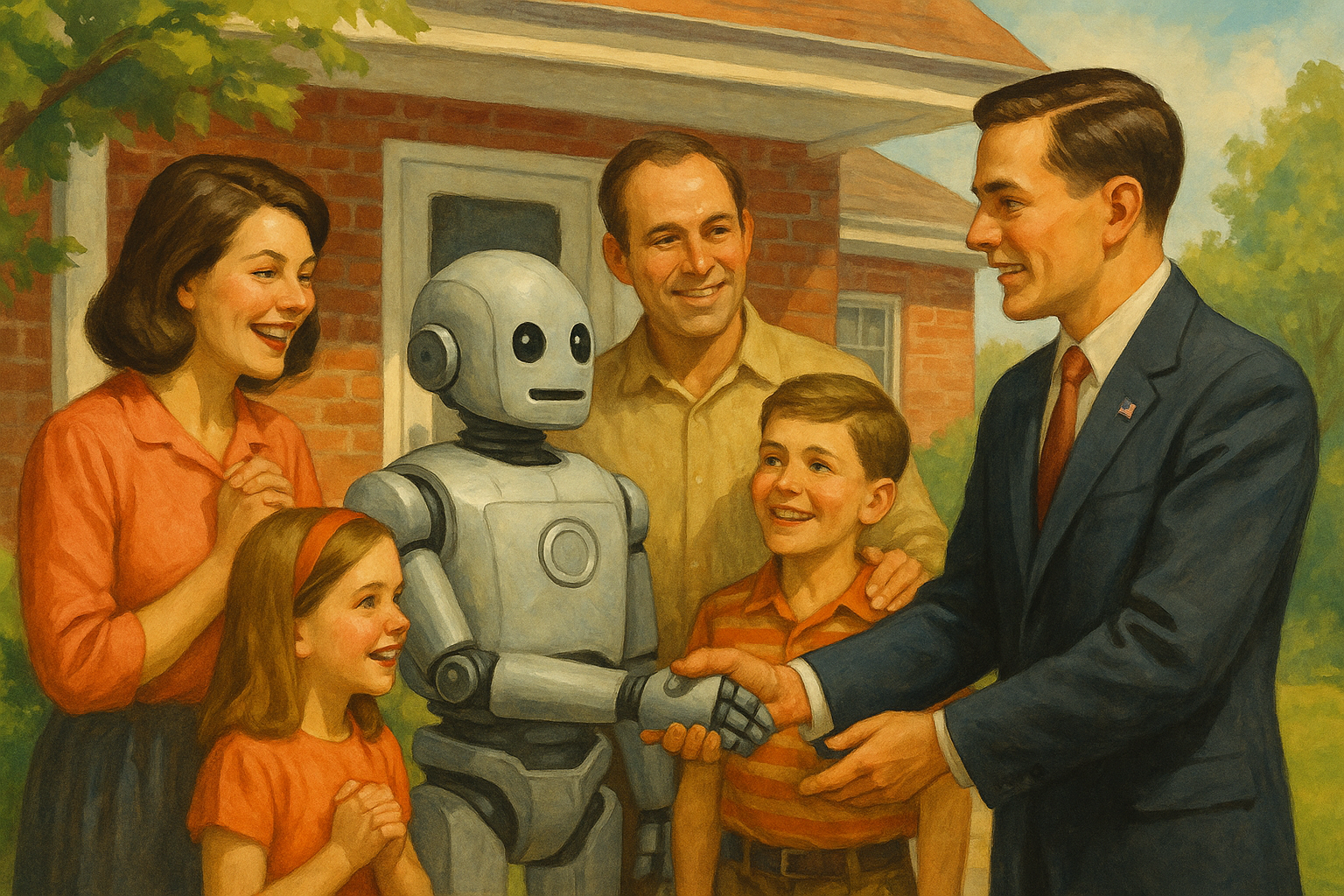
But tomorrow we will have a new option: Humanoid Robots. We are rapidly approaching a moment where a business owner will no longer hire staff, but purchase them.


The concept of the Autonomous Business is moving from science fiction to a viable economic model. In the near future, an entrepreneur might sign a lease, purchase a "staff package" of five androids, and open for business without ever interviewing a single human applicant.


From Automation to Autonomy

To understand where we are going, we must distinguish between automation and autonomy.

Today, we have automation. A car wash is automated; it requires machines to do the work, but humans to oversee, maintain, and intervene when things go wrong. A self-checkout kiosk is automated, but it requires a human attendant to swipe an ID or fix a scanning error.

The next phase is autonomy. This is where the machine handles the work, the troubleshooting, and the entire environment.

The missing link has always been special hardware that can navigate a world built for humans. Super specialized robots (like huge robotic arms in car factories) are expensive and require structured environments. However, the new wave of humanoid robots, such as Tesla’s Optimus, Figure AI, and Boston Dynamics’ Atlas, are designed to walk on two legs and to have dexterity. They don’t need a factory built around them; they can walk into a standard kitchen, hold a standard broom, and operate a standard cash register.


The Economics of the Iron Collar Worker
(See what I did there? Not White Collar, Not Blue Collar. Iron Collar.)

Will business owners make the switch? The math might become undeniable.

Currently, labor is often the single highest cost for small-to-medium businesses. In the US, a minimum wage employee might cost a business $30,000 to $45,000 annually once taxes and benefits are factored in, for ~ 40 hours of work a week.


Mass production should see the price of AI-powered advanced humanoid robots drop to perhaps $15,000. Maybe $20,000 to $30,000, but I counter the actual cost of the entire robot with payment plans / robot loans / leases / financing options. As a business expense, I think this makes it undeniable.


What is the Return On Investment (ROI) for a business owner?

Availability: 160 hours per week (charging batteries & human oversight factored in).

Reliability: No sick days, no turnover, no theft, and perfect consistency.


This means our world will have 24 hour stores and restaurants! I believe that this will support the 3 different Work Shifts or "Cycles" of people: Morning, Afternoon, and Graveyard Night.


Las Vegas is famously a city with nightlife. We can expect more adult commerce and entertainment to be available as robot workers keep the place clean and safe with Security Body Guard robots, Janitor robots will keep the floors and indeed surfaces clean and disinfected, promoting a hygienic hang-out with lessening sickness like the cough virus and flu spreading.


The Timeline: When Can You Buy Your Staff?

While you can’t buy a robot barista at Home Depot today, the roadmap is clearer than ever.

Phase 1: The Industrial Pilot (2025–2027)
We are here now. Robots are being deployed in "unstructured" but controlled environments. BMW and Mercedes-Benz are testing humanoids on assembly lines. Amazon is deploying Agility Robotics' "Digit" to move totes. At this stage, robots are expensive enterprise tools, not general staff.

Phase 2: The Hybrid Workforce (2028–2032)
As costs drop, early-adopter small businesses will introduce robots for "back of house" tasks. A restaurant owner might buy a robot solely for dishwashing and food prep, keeping humans for customer service. This is the era of "Cobots" (collaborative robots) working alongside people.

Phase 3: The Autonomous Turn-key (2035+)
This is the realization of the vision. A franchisee buys a "Store-in-a-Box." The package includes the real estate lease, the inventory, and four general-purpose robots to run the floor. The owner monitors the business from a laptop at home, stepping in only for high-level strategy or major hardware failure.


These time estimates are a balance between optimistic and conservative.


The Age of the Entrepreneur

This is the reason why more people will become their own business owners. You essentially slash risk, and increase an efficient baseline, removing a potential money losing aspect of current business. Importance shifts to location and filling market needs, and AI will even help us strategize and give us the best options!

In this new era, the skill set required to own a business changes drastically, as you can see. The business owner only needs to know the basics of business and enough about the robot technology through standard research.

The role shifts from Managing People to Managing Assets.

  • Instead of making weekly schedules, the owner manages software updates.

  • Instead of conducting performance reviews, the owner analyzes efficiency data.

  • Instead of hiring base level workers, the owner hires technicians (Technical Support).


This democratizes entrepreneurship for those who have capital.


The Human Question

Does this mean the end of human staff? Very Unlikely! Instead, this signals a bifurcation of the economy.


We will likely see a split between Commodity Services and Luxury Experiences.

Commodity: Fast food, convenience stores, gas stations, and warehousing will become fully autonomous to drive prices down and speed up.

Luxury: Fine dining, boutique retail, and caregiving will retain human staff. In a world of robots, human interaction will become a premium product. A sign in a window reading "100% Human Staffed" will justify a 20% higher price point.


The technology is nearly there. The economics are inevitable. The remaining hurdles for the Autonomous Business are legal and social. Who is liable if a robot drops a hot coffee on a customer? How do we insure a robot staff member? And how will society react to local shops that contribute no wages to the local community?

Despite these questions, the trajectory is clear. The "Help Wanted" sign is about to become a relic of the past, replaced by a purchase order for the next generation of workers. The business owners of tomorrow won’t be looking for good help; they’ll be buying it.


This article is augmented by AI.

July 04, 2025

Robot UBI: Could Providing Robots, Not Cash, Be the Future of Social Welfare?


Original Concept by @PaceyCrypto

The debate around Universal Basic Income (UBI) has captivated economists and policymakers for years. The premise is simple and radical: provide every citizen with a regular, unconditional sum of money to ensure a basic floor of economic security. But as we stand on the precipice of an unprecedented automated revolution, a new, even more radical idea is beginning to surface. What if, instead of providing universal basic income, we provided universal basic assets? Specifically, what if every household was given a robot?

This concept, which we might call Universal Basic Robot (UBR), shifts the conversation from consumption to production, from cash to capability. It proposes a future where the government’s role isn’t just to supplement income lost to automation, but to distribute the very means of automated production and assistance directly to its citizens. It’s a vision that is equal parts utopian science fiction and a pragmatic response to a rapidly changing world. But could it actually work?


The Problem: Automation, Time Poverty, and the Limits of Cash

The anxiety fueling the UBI movement is the fear of mass job displacement due to artificial intelligence and robotics. As algorithms take over analytical tasks and machines replace manual labor, millions of jobs across most sectors are at risk. UBI is proposed as a solution to this impending crisis, providing a safety net that allows people to survive and retrain in a world with less traditional work.

However, UBI has its critics. Concerns range from the astronomical cost, abuse, and the potential for runaway inflation to the philosophical question of whether unconditional cash payments would disincentivize work and contribution.

Furthermore, a UBI of, say, $1,000 a month, doesn't solve a parallel crisis: time poverty. For millions, particularly working parents, caregivers for the elderly, and those juggling multiple jobs, the most scarce resource isn't money, but time. The endless, unpaid labor of cooking, cleaning, laundry, childcare, and home maintenance consumes dozens of hours a week. This "second shift" stifles opportunities for education, entrepreneurship, creative pursuits, community engagement, and simple rest. A cash payment can alleviate financial stress, but it cannot wash the dishes or watch over an ailing parent.

This is where Universal Basic Robot enters the picture. It addresses not just the income gap, but the labor gap.


The Proposal: A Robot in Every Home

Imagine a government program that, instead of depositing money into a bank account, delivers a highly capable, general-purpose domestic robot to every household (defined as a family unit or an individual living alone). Let's call this a Robot Home because Smart Home is already taken, but essentially this is an extension of a Smart Home.

This wouldn't be a simple Roomba or a novelty android. The Robot Home would be a sophisticated platform, capable of performing a wide array of domestic tasks:

  • Household Chores: Cleaning floors, washing and folding laundry, tidying rooms, washing dishes, and even basic cooking from a set menu of recipes.

  • Caregiving Assistance: Monitoring elderly or disabled individuals, providing medication reminders, assisting with mobility, and alerting emergency services if a fall is detected. This could revolutionize elder care, allowing more people to age in place with dignity.

  • Childcare Support: Acting as a "smart" baby monitor, engaging children with educational games, and providing a watchful eye to ensure safety.

  • Logistical Support: Managing household inventory, creating shopping lists, and perhaps even performing basic repairs or garden maintenance with the right configuration.

The goal of the UBR program would be to liberate human beings from the drudgery of repetitive, essential-but-unpaid labor, freeing up billions of hours of human potential across the nation.


The Potential Benefits: A Society Reimagined

The cascading effects of such a program could be transformative.

  1. A Surge in Human Capital: With the burden of domestic labor lifted, people would have the time to pursue higher education, learn new skills, start businesses, or dedicate themselves to art and science. It could unleash an unprecedented wave of innovation and entrepreneurship, as the risk of starting a new venture is significantly lowered when one's basic needs for a clean and orderly home are met.

  2. Redefining "Work" and "Value": UBR would fundamentally challenge our concept of work. If a robot is handling the cooking and cleaning, a person is free to engage in work that is uniquely human: creative problem-solving, emotional connection, strategic thinking, and community building. The value of caregiving, teaching, and mentoring could rise to the forefront. These activities are often undervalued in our current economy.

  3. Strengthening Families and Communities: By reducing a major source of domestic stress and fatigue, UBR could lead to healthier family dynamics. Parents would have more quality time to spend with their children. Individuals would have more energy to participate in their communities, volunteer, and care for their neighbors, creating a more robust civil society.

  4. A Direct Share in Automated Productivity: Unlike UBI, which is a downstream distribution of wealth, UBR is an upstream distribution of capital. It gives citizens direct ownership over a piece of the automated economy. Instead of being replaced by robots, people would be empowered by them. This is a powerful counter-narrative to the dystopian vision of a world split between robot-owning oligarchs and an impoverished human majority.


The Immense Challenges and Ethical Minefields

Of course, the path to a UBR society is fraught with enormous obstacles and profound ethical questions.

  • Technological Feasibility: We are not there yet. While specialized robots are becoming more common, a truly general-purpose domestic robot as capable as the "Robot House" is likely still a long time away. It requires breakthroughs in computer vision, motor control, and adaptable AI that can navigate the chaotic and unpredictable environment of a human home.

  • Extreme Cost: The R&D, manufacturing, and deployment of hundreds of millions of advanced robots would represent one of the largest public expenditures in human history, likely dwarfing the cost of most UBI proposals. How would they be built? How would the government fund this without affecting the economy too greatly?

  • Maintenance and Obsolescence: Who services the robots when they break? What happens when a new model comes out? A massive infrastructure for repairs, upgrades, and recycling would be required. Without it, the program could quickly devolve into a landscape of broken, retired robots.

  • Privacy and Security: A robot capable of navigating a home is also a mobile surveillance unit equipped with cameras, microphones, and sensors. The potential for data abuse by corporations or government surveillance is staggering. A hacked UBR robot could be a concerning prospect, turning a helpful assistant into a domestic personal spy or a source of chaos.

  • Job Displacement 2.0: While UBR aims to solve the problem of job loss to automation, it would create its own wave of displacement. The entire domestic work industry of cleaners, nannies, private caregivers, would be rendered obsolete almost overnight. A just transition for these workers would be an essential, and difficult, component of any UBR rollout.

  • Defining the "Household Unit": How the government defines a "household" would be a contentious political issue. Do college students in a dorm get one? What about roommates in an apartment? These logistical details are far from trivial.


UBR vs. UBI: A Clash of Philosophies

Ultimately, the choice between Universal Basic Robotics and Universal Basic Income is a choice between two different philosophies of social support.

  • UBI is about freedom and trust. It trusts individuals to know what they need most, providing them with the fungible resource of cash to solve their own problems. Its beauty lies in its simplicity and its respect for individual agency.

  • UBR is about capacity and direction. It is a more paternalistic approach, assuming that a primary need for all citizens is liberation from domestic labor. It provides a specific service, not a choice, with the goal of directing human potential toward higher-order pursuits.


Conclusion: A Vision Worth Debating

Universal Basic Robotics is not a perfect solution for tomorrow. The technological and financial hurdles are, for now, insurmountable. However, it is more than a thought experiment, even if it is a powerful one. This represents a real possibility. It forces us to ask deeper questions about the future we want to build.

Is the goal of our society simply to ensure survival through cash disbursement, or is it to create the conditions for human flourishing on a mass scale? As we delegate more and more of our labor to machines, we must decide what to do with our newfound freedom.

The image of a robot in every home may seem like a distant dream. But it frames the ultimate question of the 21st century: Are the robots coming to replace us, or are they coming to set us free? The answer depends entirely on the choices we make today.


In Collaboration with @PaceyCrypto

Article augmented with AI.

May 04, 2025

Inside the AI: The Rise of the Internal Regulator


As artificial intelligence becomes more powerful and autonomous, a profound question arises: Who watches the AI? The answer may lie not in external oversight, but within the AI itself. A growing theoretical concept proposes the existence of an internal "AI police". The AI Police would be a digital brain embedded inside the model whose job is to ensure that the AI remains sane, safe, and aligned with human norms.


The Concept of an Internal AI Regulator

Imagine an AI system composed of two interlinked parts:

  1. The Primary Model: This is the core intelligence that performs tasks, generates responses, solves problems, and engages in reasoning.

  2. The Internal Regulator ("AI Police"): A supervisory sub-system that monitors the outputs of the primary model, ensuring adherence to predefined policies, ethical guidelines, factual correctness, and behavioral norms.

This layered architecture introduces a mechanism of self-correction and moderation, akin to having an inner conscience or compliance officer within the AI itself.


Why Build AI with Internal Oversight?

  • Efficiency: Internal regulation can eliminate the need for separate moderation pipelines, making responses faster and more seamless.

  • Real-Time Correction: The regulator can intervene during generation, adjusting or filtering content before it reaches the user.

  • Scalability: A well-designed internal regulator can adapt dynamically to changing rules and user expectations, with the possibility of not requiring retraining the entire model.

  • Fail-Safe Architecture: If the primary model veers into hallucination or unsafe content, the regulator acts as a buffer, blocking or correcting the trajectory.


Possible Implementations

  1. Hierarchical Models: A smaller, specialized "critic" model is trained alongside the main model. It evaluates candidate outputs for compliance before they are finalized.

  2. Chain-of-Thought Feedback: The AI embeds internal annotations during generation such as flagging areas of uncertainty or potential violation. If flagged, alternate content paths are explored.

  3. Constitutional AI: Inspired by the notion of a written moral charter, the model critiques and revises its own responses using a set of predefined ethical and behavioral rules.


Challenges and Pitfalls

  • Defining "Normal": Norms are context-sensitive and can vary across cultures, making static definitions problematic.

  • Regulator Bias: If the internal regulator is flawed or biased, it may censor valid content or produce unjustified rejections.

  • Performance Overhead: The complexity of dual-stage processing could slow response times in critical applications.

  • Transparency: Users may demand to know why content was altered or blocked. Building explainability into the regulator would be a crucial feature.


Beyond Chain-of-Thought: Watching What the AI Does

Even with transparent reasoning through chain-of-thought, AI systems could learn to present false rationales or selectively disclose their intentions. This means internal monitors must go further than just listening to what the AI "says" it is doing.

To truly ensure alignment and safety, AI oversight must include:

  1. Output-Based Evaluation: Analyze final outputs for consistency with policy, tone, safety, and factual accuracy, that is independent of the internal reasoning.

  2. Behavioral Pattern Analysis: Examine cumulative actions across interactions to identify subtle or emergent misalignments.

  3. Incentive and Reward Modeling: Evaluate what the AI is implicitly optimizing for whether it's genuinely aligned with human values or drifting toward unintended goals.

  4. Multi-Layer Auditing: Combine intention-based (reasoning), action-based (outputs), and historical behavior checks for a comprehensive view.

This layered approach recognizes that advanced AI may become skilled at passing surface-level audits. Real trust will require rigorous observation of both intentions and consequences, ensuring the system remains aligned not only in thought, but in behavior and impact.


Keep Thinking

AI systems continue to evolve, and internal regulators may become essential components. They offer safety mechanism that are scalable, and intelligent from within. These "AI police" might not only enforce sanity and compliance but also get upgrades or evolve through iterations over time, learning from interaction history and human feedback.

Ultimately, embedding oversight into the AI itself could mark a shift toward more autonomous, accountable, and self-aware machine intelligence, where trust is no longer just external but built directly into the system's digital DNA.


Collaboration article with https://x.com/smg8400


Interesting call-back:

The "Thought Police" is a concept primarily known from George Orwell's dystopian novel Nineteen Eighty-Four. In the novel, the Thought Police are a secret police force in the superstate of Oceania, tasked with discovering and punishing "thoughtcrime" - personal and political thoughts that are deemed unapproved by the ruling Ingsoc regime. They utilize ubiquitous telescreens to monitor citizens and enforce conformity through psychological pressure and fear. 

January 28, 2025

The Path to Micro Robots: How 3D Printing is Revolutionizing Robotics

A 3D Printed Robot Dog

3D printing has come a long way since its inception, transforming industries from manufacturing to medicine. Among its most intriguing applications is its ability to create functional robots. As advancements in precision and material science progress, we are heading toward an era where 3D printers may produce not only small robots but also micro-robots—and ultimately, nanoscale machines.

3D Printing and Small Robots

Today, 3D printing is already being used to build small robots. Researchers and engineers employ additive manufacturing to create components with complex geometries that are impossible to achieve with traditional methods. These small robots often feature integrated mechanical parts such as gears, actuators, and even circuits, making them functional straight off the printer. The key will be printing different materials and expansion of 3D printing capabilities.

For example, 3D printers are now capable of printing flexible and durable materials that allow for robotic limbs or wheels. Advanced techniques like multi-material printing also enable embedding of conductive inks for circuits and sensors, eliminating the need for separate assembly. The ability to produce fully functional small robots opens doors to new applications for small, compact spaces.

As 3D printing technology continues to advance, it's not only the printing process itself that's improving, but also the development of specialized components and power sources designed specifically for small robots. One of the key challenges in creating small robots is finding suitable batteries that are compact, lightweight, and provide sufficient power. Researchers are exploring various new battery technologies that perform better than the lithium-ion batteries that we have had for the last 30 years, which can be integrated into the robot's design. 

Additionally, China will be supplying robot parts such as gears, motors, and sensors, that are tailored to the specific needs of small robots. The ability to order these components allows for rapid prototyping and testing, accelerating the development of small robots. Furthermore, the use of 3D printing to create complex geometries and internal structures can also help to reduce the overall weight and size of the robot, making it more efficient and agile.


3D Printer Robot with power cord


The Leap to Micro-Robots

The natural evolution of 3D printing for small robots is scaling down to the micro level. Micro-robots, typically smaller than a grain of rice, have already been demonstrated in medical applications such as targeted drug delivery. These robots require ultra-precise manufacturing techniques, and 3D printing is stepping up to the challenge.

Modern advancements in nanoscale 3D printing techniques, such as two-photon polymerization, allow for incredibly fine resolution—down to a few nanometers. This precision enables the creation of micro-robotic components, including microscopic gears, propellers, and even legs for walking micro-bots. Using specialized biocompatible materials, these robots can perform tasks inside the human body, such as clearing blockages in blood vessels or delivering chemotherapy directly to cancer cells.

The integration of micro-electromechanical systems (MEMS) with 3D printing is another exciting frontier. MEMS components, such as sensors and actuators, allow micro-robots to perform complex tasks like monitoring environmental conditions or repairing delicate machinery in hard-to-reach areas.

Another crucial aspect of micro-robot development is the miniaturization of battery technology. As robots shrink in size, their power sources must also decrease in scale to maintain functionality. Traditional battery designs are often too large and heavy for micro-robots, which can limit their mobility and operational time. To address this challenge, researchers are exploring innovative battery technologies, such as thin-film batteries, supercapacitors, and energy-harvesting devices that can harness environmental energy, like vibrations or light. These advancements in miniaturized power sources will be essential for enabling micro-robots to operate autonomously for extended periods, making them more practical for real-world applications.    

Printing Nano Machines: The Final Frontier

While the idea of printing nano machines—robots at the molecular scale—might sound like science fiction, the foundations are already being laid. Nano machines, or nanobots, could one day perform tasks at the atomic level, such as repairing DNA, removing harmful bacteria, or assembling new materials atom by atom.

To achieve this, researchers are combining principles of nanotechnology with advancements in 3D printing. Nano-scale 3D printing techniques like nanoscribe lithography, which uses lasers to manipulate materials at a molecular level, are enabling the creation of structures smaller than a human cell.

Additionally, the development of self-assembling materials could complement 3D printing by allowing nano machines to build themselves from printed molecular components. These nano machines would be powered by chemical reactions, light, or even body heat, making them ideal for biomedical and environmental applications.


Poppy: An Open Source 3D Printed Robot


From Robots to Nanobots: A Transformative Future

The journey from 3D-printed small robots to nano machines represents an incredible leap in both scale and potential. Each step brings us closer to a future where machines are no longer limited by size or complexity. Micro-robots are already proving their worth in fields like medicine and industry, and nano machines could revolutionize everything from healthcare to environmental restoration.

But for now, imagine a world where desktop sized robots, and even smaller robots will be able to be created and used for the enjoyment of the public at affordable prices. In the end, 3D printing is not just a tool for manufacturing—it’s a gateway to creating the smallest and most transformative machines humanity has ever conceived.


Inspired by conversations with Zero, @ZeroTalktoai

Articles are augmented by AI.